Servings: 5
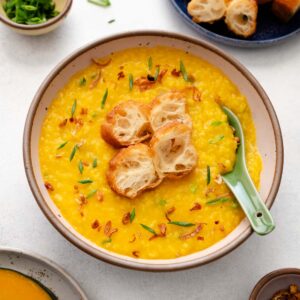
Kabocha Congee
This kabocha congee feels like a warm hug on a cozy day. The congee gets subtle sweetness from kabocha purée along with a variety of fragrant flavors from shallots, lemongrass, and ginger. Enjoy this kabocha congee for breakfast, lunch, or dinner! The main recipe below uses chicken broth and fish sauce. For a vegan version, see note 1.This recipe will walk you through how to make kabocha purée from scratch. If you’d rather not make it from scratch, feel free to use a 15-ounce can of pumpkin instead. Make sure to use pumpkin purée and not pumpkin pie filling.
Ingredients
Kabocha Purée
- 1 kabocha squash, about 3 to 4 pounds
Kabocha Congee/Jook
- 2 stalks of lemongrass
- 2 tablespoons oil, you can use any oil
- 1/2 cup (70g) minced shallots
- 2 tablespoons minced ginger
- 1 cup (200g) jasmine rice, rinsed (see note 2)
- 4 cups (945mL) chicken broth, (see note 3)
- 5 cups (1.18L) water
- 1 3/4 cups (420g) kabocha purée
- 1/2 cup (30g) sliced scallions
- 2 tablespoons fish sauce, plus more to taste
Optional Toppings
- Chinese donuts/youtiao, (see note 4)
- sliced scallions
- fried shallots
Instructions
Make Purée
- Using a sharp knife or cleaver, slice the kabocha open in half. Scoop out the seeds and strings with a spoon. Place the kabocha halves cut side down, and slice off the stem. Cut one half into 1-inch thick slices. You’ll need about 750 to 780 grams of kabocha slices to make enough purée for this recipe. Weigh the slices to see if you have enough and slice more, if necessary. If you have a lot of excess squash, feel free to steam all of it to make a purée, or roast the squash and use it in a salad.

- Add a steaming rack to a large wok. Fill the wok with water, until there’s about a 1/4-inch gap between the water level and the top of the rack. Bring the water to boil. Arrange the kabocha slices over a large plate. You can stack the kabocha slices if you don’t have enough room to arrange them in a single layer. Carefully place the plate of kabocha slices over the steaming rack. Cover the wok with a lid and steam the kabocha for 20 to 23 minutes, until the kabocha flesh is very fork tender. If you have another steaming setup, feel free to use that. (See note 5 for roasting instructions.)

- Let the kabocha cool for a few minutes. Use a spoon to separate the kabocha flesh from the skins. Then, use a fork to mash the kabocha flesh until smooth. If you want a smoother purée, press the purée through a mesh strainer, but it is not necessary to do so. Measure out 1 3/4 cup (420g) of purée and set it aside (see note 6).

Prepare Lemongrass
- Peel away any dry outer layers of the lemongrass. Then, rinse the lemongrass stalks.

- Slice off the thin tops off the stalks of the lemongrass. You can save them for another use or discard them (see note 7). The bottoms of lemongrass stalks tend to be a little dry. Slice off the bottom 1/4 inch of the stalk.

- Slice each stalk of lemongrass into thirds so that you should be left with 6 total sections. Using a kitchen mallet, bash the lemongrass sections a few times to release its aroma.

Make Congee
- Pour the oil into a large pot over medium-high heat. Add the lemongrass and let it sizzle in the pot for 1 to 2 minutes. Next, add the shallots and sauté a minute more. Add the ginger and sauté for another 30 seconds to a minute.

- Transfer the rice to the pot. Then, add the chicken broth and water. Cover the pot with a lid and bring to boil.

- Reduce the heat to low. I usually move the pot to the smallest burner on the stove so that the congee can cook very slowly. Let the congee simmer for 30 minutes. Add the kabocha purée and stir until the purée is well incorporated.

- Cover the pot and continue cooking the congee for another 15 minutes. Because of the sugar content in the kabocha, the jook will start to scald at the bottom of the pot. Give the jook a stir, carefully scraping the bottom for any kabocha build-up. Cover the pot again and cook for another 10 minutes.
- Turn off the heat and give the congee a stir. The congee should be quite thick at this stage. If you want the congee to be thicker, let the congee cool in the pot, uncovered, for another 15 to 20 minutes. The congee thickens as it cools and the flavor of the kabocha develops further.
- Use tongs to fish out the sections of lemongrass. Add the scallions and fish sauce into the pot and stir to incorporate.

- Serve the kabocha congee in bowls with Chinese donuts, additional scallions, and fried shallots, if you like. Refrigerate any leftovers in an airtight container for up to 4 days. I usually reheat the congee in the microwave for 1 to 2 minutes. You can also reheat the congee in a saucepan.
Notes
- Vegan Version: The cooking process is very similar to the one described above, with a few changes. Instead of using chicken broth, use vegetable or mushroom broth. To give the congee extra umami flavor, I like to also add 5 to 6 whole dried shiitake mushrooms. Rehydrate the mushrooms by covering them with hot water for 15 to 20 minutes. Add the mushrooms the same time you add the shallots. You can also add the water to the pot (unless there's a lot of debris in it). Once the congee is done cooking, instead of adding fish sauce, add 2 1/2 tablespoons of white miso. In a small bowl, mix the miso with 1/4 cup of the hot congee until the miso is completely dissolved. Then, add the miso mixture to the congee. Taste the congee and season with salt, if necessary. You can also use 2 tablespoons of Yondu, a vegetable-based seasoning, instead of miso.
- Rinsing Rice: You don’t need to rinse the rice too thoroughly, as you want the starch in the rice to thicken the congee. One change of water should be fine.
- Broth and Water: If you are using boxed broth or making broth from bouillon, I recommend using a combination of broth and water because the broth can be rather salty. However, you can make the porridge with broth only. Just know that you may need to adjust the fish sauce later on.
- Chinese Donuts (Youtiao/油條): I typically buy youtiao frozen from Asian grocery stores. I reheat them by baking the donuts at 350ºF (175ºC) for 15 to 17 minutes, until crispy. Slice them up to serve.
- Roasting Kabocha: Arrange the kabocha over a parchment-lined baking sheet and drizzle with a bit of olive oil. Roast the squash at 375ºF (190ºC) for 30 to 35 minutes, until fork tender.
- Leftover Kabocha Purée: If you have only 1/4 to 1/2 cup of kabocha purée left over, just add it into the pot for the congee. Otherwise, feel free to use the leftover purée by adding it to oatmeal, soups, chowders, or my pumpkin dinner rolls.
- Lemongrass Tops: There are several things you can do with the tops. You can rinse and dry the tops and then use kitchen scissors to cut them into 1/2-inch pieces. Add them to your favorite herbal teas or chai. You can also use the tops to make broth. I recommend bundling up the tops and tying them with string before adding to the pot (see photo below). That way, the tops will be easier to fish out.
Nutrition
Serving: 1.5cups | Calories: 155kcal | Carbohydrates: 22.5g | Protein: 3.8g | Fat: 6.3g | Saturated Fat: 0.9g | Cholesterol: 4mg | Sodium: 1311mg | Fiber: 1.9g | Sugar: 4.5g
Did you make this recipe?Tag @hellolisalin or leave a star rating and comment on the blog!