Servings: 10
Lotus Root Upside Down Cake
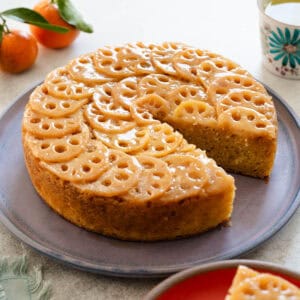
Make this show-stopping lotus root upside down cake for your Lunar New Year gatherings! Infused with orange and ginger flavors, the cake is light and moist and the lotus root topping retains a light crisp. This cake takes some time to prepare, but you can break up the work into 2 days. See the notes below on how to break up the work into 2 days. Recipe adapted from Pamelia Chia’s lotus root upside down cake from Wet Market to Table and Asha Loupy’s Stone Fruit Upside Down Cake. Cake serves 8 to 10.
Ingredients
Lotus Root & Glaze
- 2 large oranges, rinsed and dried
- 7.75 to 9.75 ounces (220 to 275g) lotus root, about 2 to 2 1/4-inches in diameter, (see note 1)
- 2/3 cup (155ml) water
- 3/4 cup (150g) granulated sugar
- 3 1/8-inch (4mm) thick slices of ginger
Caramel
- 1/4 cup (56g) unsalted butter
- 1/2 cup + 2 tablespoons (75g) light brown sugar
- 3/4 teaspoon (3g) Diamond Crystal kosher salt, or 3/8 teaspoon fine sea salt
Cake
- 1 1/2 cups (180g) all-purpose flour, plus more for dusting
- 1 tablespoon ground ginger
- 1 1/2 teaspoons baking powder
- 1/2 teaspoon baking soda
- 1 teaspoon (4g) Diamond Crystal kosher salt, or 1/2 teaspoon fine sea salt
- zest from 1 orange
- 2/3 cup (132g) granulated sugar
- 2 large eggs
- 1/3 cup (75ml) safflower, canola, or any neutral-flavored oil
- 1/4 cup (56g) unsalted butter, melted
- 3/4 cup (185g) full-fat (or whole) Greek yogurt, (see note 2)
- 2 teaspoons orange blossom water or vanilla extract, (see note 3)
Instructions
Preheat Oven & Prepare Pan
- Preheat the oven to 350ºF (175ºC). Position oven rack to the center.
- Grease an 8-inch or 9-inch cake pan and lightly flour it (see note 4 for tips on baking with a 9-inch pan). Flip the cake pan over and tap out any excess flour. Then set aside the pan.

Prepare Oranges
- Use a microplane zester to zest one of the oranges and put the orange zest aside. You should have about 1 tablespoon (6 to 7 grams) of orange zest. With the other orange, use a sharp knife to carefully cut off 4 strips of orange peel. Try your best not to cut off too much of the white pith. Set the strips of peel aside.
- Juice both oranges. You should have about 2/3 to 3/4 cup (155 to 175ml) of orange juice. Strain the juice to remove the pulp and set aside. You don’t want orange pulp all over the lotus root slices, so it’s best to strain the orange juice.

Prepare Lotus Root
- Cut off the joints (or the knobby ends) of the lotus root and peel the skin with a vegetable peeler. Take a look inside the cavities. If you see any dirt, use a straw cleaner to clean out the cavities.

- Use a mandoline slicer to slice the lotus root into 1/8-inch (4mm) thick slices. When using a mandoline, I always wear cut-resistant gloves to be safe. When you get down to about 1 1/2 inches of lotus root left to be sliced and getting it through the blade gets difficult, stop there. There is no point trying to force the last section of lotus root through the blade and risk cutting yourself, even with gloves on. You can also slice the lotus root into thin slices using a sharp knife.
- Let the lotus root soak in water for 5 to 10 minutes to remove some of the starch.

- Drain the lotus root. In a large saucepan, add the freshly squeezed orange juice, water, 3/4 cup sugar, ginger slices, strips of orange peel, and lotus root. Bring the liquid to boil. Reduce the heat to medium and let the lotus root simmer for 10 minutes. Turn off the heat, and let the lotus root cool for 5 to 10 minutes.

- Use a fork to transfer the lotus root slices to large plates or a small sheet pan. Do not pour out the poaching liquid. I like to group lotus root slices of similar size. This organization will come in handy when you arrange the lotus root in the pan. (See note 5 about preparing the lotus root ahead.)

Make Caramel
- Melt the butter, brown sugar, and salt in a saucepan over medium-high heat. Once the butter is nearly done melting, start whisking everything together, until you get a relatively cohesive caramel in the saucepan. It’s fine if there’s a tiny bit of excess butter around the edges.

- Turn off the heat and immediately pour the caramel into the prepared cake pan. Using a flexible spatula, scrape out all the caramel from the saucepan. Tilt the cake pan around so that the caramel covers the entire surface. If you are struggling, use the spatula to help you spread out the caramel. This caramel hardens pretty quickly, so it is important to work quickly at this stage.
Finish Preparing Cake
- Arrange Lotus Root in Pan: When the lotus root is cool enough to handle, Start fanning out the lotus root slices over the caramel, starting from the outer perimeter of the cake pan and working your way in. Make sure the lotus root slices overlap each other at the halfway point of each slice to ensure a tight pattern. I like using the largest lotus root slices for the outer ringer and slightly smaller slices for the inner ring(s). Finally, I place the smallest slice of lotus root (usually the one closest to the joint) at the center. For reference, I usually use 29 to 32 slices of lotus root to cover an 8-inch pan. (See note 6 if you have any torn or ripped lotus root.)

- Whisk together the all-purpose flour, ground ginger, baking powder, baking soda, and salt.
- In a small bowl, rub the orange zest with the 2/3 cup of sugar, until there are no longer any large clumps of zest and the sugar has turned orange.

- In a large bowl, whisk together the eggs, oil, and 1/4 cup of melted butter. Then, whisk in the Greek yogurt and orange blossom water (or vanilla). Finally, mix in the sugar with orange zest, until smooth. Add the dry flours to the wet ingredients all at once. Use a wooden spoon to mix everything together, until just combined and you don’t see streaks of dry flour.

- Carefully scoop the batter into the cake pan, over the lotus root slices. Use an offset spatula or a spoon to smooth over the batter until it is an even layer.

- Bake the cake for 40 to 43 minutes, until a skewer inserted into the center of the cake comes clean. Start checking the cake at 38 minutes for a 9-inch cake. The top of the cake should be a rich golden brown color. I like to rotate the cake after 25 minutes of baking and then bake for 15 minutes more.
Reduce Poaching Liquid
- While the cake is baking, bring the leftover poaching liquid to a boil and simmer on medium-low for about 6 to 8 minutes, until the liquid thickens to a light syrup texture (like maple syrup). When you dip a spoon into the liquid, it should lightly coat the spoon.
Serve Cake
- Let the cake cool in the pan for 10 minutes. Run a butter knife around the edge of the pan to ensure the cake has loosened. Then, place a large plate over the cake. The cake pan is still quite hot, so wear oven mitts or use a tea towel to help you flip the cake over and onto the plate. Use the knife to help pry the lid off the cake.
- You now have the option to glaze the cake with the syrup or not. If you plan to serve this to people who prefer desserts that aren’t too sweet (like my mom), leave the cake unglazed. Otherwise, brush a thin layer of glaze over the cake. The glaze gives the lotus root extra shine. If you let the cake cool to room temperature, and the lotus root pattern is looking a bit dull, brush a thin layer of glaze on top to refresh it. I wouldn’t do more than 2 thin layers. See note 7 for ideas on how to use the leftover glaze.
- Serve the cake immediately or at room temperature. I’ve made this cake 4 hours ahead, and it was fine when I was ready to serve it. If desired, serve the cake with lightly sweetened whipped cream.

Notes
- Selecting Lotus Root: To make the most visually appealing cake, you want to choose round lotus root that’s on the thinner side (about 2 to 2 1/4 inches in diameter). A smaller root will allow you to create more rings of lotus root on the cake. You also want to pick lotus root with peach skin and minimal black or brown patches. Refer to this post for more tips on how to pick lotus root. I did not test this recipe with packaged, poached lotus root.
- Using plain whole yogurt (not Greek yogurt): I tested a batch of the cake using plain whole yogurt out of curiosity. Because plain yogurt isn’t strained, there’s less fat content compared to the same volume of whole Greek yogurt. As a result, the cake was a little drier, but still good. You can replace plain whole yogurt for the Greek yogurt in a pinch, but expect a cake that is less moist. Similarly, you can use low-fat Greek yogurt, but the cake may be drier.
- Orange blossom water: I love the delicate, floral flavor of orange blossom water and how it complements the orange zest and ginger in the cake. If this is difficult for you to source, feel free to use vanilla instead.
- Baking with a 9-inch pan: If you’re baking with a 9-inch pan, the cooking directions are basically the same, but there are a few things to look out for: A) Make sure you have at least 250 to 300 grams of lotus root to begin with. You want to make sure you have enough lotus root to cover the surface of the cake. B) The cake should finish baking about 2 to 3 minutes sooner than when you bake with an 8-inch pan.
- Breaking up the work: You can easily break up the baking process into 2 days. On the first day, you’ll prepare and poach the lotus root and make the orange and ginger glaze. Follow the steps up to the point where you take the lotus root slices out of the poaching liquid. Let the lotus root cool completely on plates or a sheet pan. Then, transfer the lotus root to a container and place a small sheet of parchment, wax paper, or plastic wrap over the lotus root. Refrigerate the lotus root until you are ready to bake the cake. The lotus root should be fine in the fridge for up to 2 days. Next, reduce the poaching liquid into a syrup, as directed above. Let the syrup cool in the saucepan and transfer to a jar and refrigerate.
- Ripped lotus root slices: The lotus root can be delicate and you may accidentally rip a slice as you prepare the cake. When arranging the slices inside the cake pan, I like to overlap any ripped portions of lotus root over another slice. When you flip the fully baked cake over at the end, any ripped portions should be hidden.
- Leftover glaze: I’ve used the glaze in place of maple syrup when making granola. I also made a quick dipping sauce with the glaze by mixing 1/4 cup of glaze, 3/4 teaspoon kosher salt, 2 tablespoon rice vinegar, and 1/4 teaspoon granulated garlic. Feel free to adjust these ingredients to your taste. The glaze should keep in the fridge for 3 to 4 weeks.
Nutrition
Serving: 1slice | Calories: 337kcal | Carbohydrates: 38g | Protein: 5.8g | Fat: 18.7g | Saturated Fat: 7.2g | Cholesterol: 64mg | Sodium: 271mg | Fiber: 1.8g | Sugar: 19g
Did you make this recipe?Tag @hellolisalin or leave a star rating and comment on the blog!