Servings: 13 cakes
Sweet Rice Cakes with Red Bean Paste
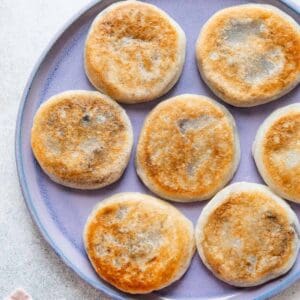
These sweet rice cakes (糯米餅) have a chewy mochi-like exterior and a smooth red bean paste filling. This recipe makes 13 to 14 cakes, but you can easily double the recipe below for a larger batch (which is my mom’s original recipe). I used my homemade red bean paste, which is a lot less sweet than store-bought versions. When measuring dry ingredients, I typically use a scale, and I measured the flours and sugar by weight when testing the recipe. I recommend that you do the same if you own a scale.You can either cook the cakes in the oven or pan fry them. The cakes are less greasy using the oven method, but they do not brown. My preferred method is to pan fry the cakes. They develop a lovely golden crust, but the cakes will be greasier to touch.
Ingredients
- cooking spray, see note 1
- 1 1/3 cups (about 400g) red bean paste
- 2 cups + 1 tablespoon (225g) glutinous rice flour, dry measurements using the spoon-and-sweep method (see note 2)
- 2 tablespoons (15g) wheat starch, can sub with tapioca starch
- 1 1/4 cups (295mL/286g) water
- 1/2 cup (100g) granulated sugar
- 1 tablespoon vegetable, canola, or any other neutral-flavored oil, plus more for frying cakes
Instructions
- Grease 3 large plates with cooking spray. Set them aside.
- Using a medium cookie scoop or a large spoon, scoop out 1 1/2 tablespoons (27 to 29 grams) of red bean paste. Transfer to a greased plate. Continue dividing the bean paste until you get 14 portions total. Grease your hands with cooking spray and roll the pieces of bean paste into balls. Place the balls back onto the plate.

- In a mixing bowl, whisk together the glutinous rice flour and wheat starch. If possible, place a silicone mat under the bowl. This will help keep the bowl in place when you mix the dough.
- Add the water and sugar to a saucepan and bring to a boil. Right when the water starts boiling, turn off the heat. Stir the liquid to make sure the sugar has dissolved completely. (Important note: DO NOT boil the water in an electric kettle. The dough will not form properly when you do that.)
- Immediately pour the hot sugary liquid into the bowl with the flours. It'll look like a lot of water at this stage but don't worry. Next, add the oil to the bowl. Use a wooden spoon to stir the liquid and flours together as you pour the hot liquid. The heat of the liquid is critical to making the dough stretchy and pliable. Once the water cools, even for several minutes, the dough will not be the optimal texture (i.e., it won't be stretchy enough). Continue stirring everything until it looks like the flours have absorbed all the liquid.

- The dough will be too hot to handle with bare hands at this stage. Grease a silicone spatula with cooking spray. Scrape off any dough that's stuck to the wooden spoon. Then, use the spatula to press and fold the dough together (see note 3). After about 2 to 3 minutes of working the dough, you should see a cohesive and smooth dough. If, for whatever reason, the dough still looks watery, add a bit more glutinous rice flour and work the dough again.

- This is a very sticky dough! Grease your hands with cooking spray to keep the dough from sticking to your hands. Reapply cooking spray to your hands if you feel the dough starts to stick.
- Grease a large spoon or measuring spoon with cooking spray, and scoop out 7 pieces of dough that are about 2 tablespoons (45 to 47 grams) each. If the dough starts sticking to the measuring spoon, reapply cooking spray. Transfer the dough pieces to a greased plate. Cover the mixing bowl with a plate or silicone lid to keep the remaining dough warm.
- Roll one piece of dough into a ball. Use the palms of your hands to flatten the dough into a disc of about 2 1/2 to 3 inches wide. Place a piece of red bean paste in the center of the dough.

- Enclose the bean paste inside the dough.

- Roll the filled dough into a smooth ball. Using the palms of your hands, flatten the ball into a dish of about 2 1/2 to 3 inches wide and 1/2 inch thick. Transfer the flattened cake to a greased plate.

- Continue shaping the remaining 6 pieces of dough into flat cakes. If the dough starts feeling crusty, knead it with your fingers until it no longer feels crusty. Once you’ve finished shaping 7 cakes, uncover the remaining dough inside the bowl. Divide the dough into 2-tablespoon pieces and shape into cakes. There should be enough dough to make 13 to 14 cakes.
- Oven Method (cakes less greasy but no browning): Preheat the oven to 350ºF (175ºC). Position an oven rack to the center position. Grease a baking sheet with cooking spray or line it with parchment paper. Arrange the cakes over the baking sheet and bake for 8 minutes. Flip all the cakes over to the other side and bake again for another 6 to 7 minutes. Don’t over-bake the cakes because the red bean paste can leak out of the cakes.

- Pan-Frying Method (brown crust on cakes but greasy to touch): Heat a large nonstick pan with 1 to 1 1/2 tablespoons of oil over medium-low to low heat (see note 4). Don’t turn the heat on too high because the sugar content in the dough will cause the surface to brown (and potentially burn) quickly. I know many of you want to crank up the heat when pre-heating a pan, but don't do that here. Just let the pan heat up slowly. Once heated, add half the cakes and pan fry for about 3 to 4 minutes, until they start to brown. If the cakes are browning much quicker than that, reduce the heat. Flip the cakes over and pan fry the other side for another 3 to 4 minutes, until golden brown. The sides of the cakes should puff up slightly. Transfer the cooked cakes to a plate.

- Add a small drizzle of oil to the pan and cook the remaining cakes. Because the pan is hotter now, the cakes may brown faster. Keep an eye on the cakes and reduce the heat if they brown too quickly.
- Let the cakes cool for at least 10 to 15 minutes before eating, as they are incredibly hot straight off the pan or out of the oven.
- Store any uneaten cakes in a container and refrigerate. Reheat the cakes in a nonstick pan for a few minutes. If you are reheating oven-baked cakes, you’ll want a bit of oil on the pan; if you are reheating pan-fried cakes, no additional oil is necessary.
Notes
- Using Cooking Spray: Cooking spray is better than plain oil in keeping your hands from sticking to the dough. When I tried greasing my hands with oil, I found that I had to reapply oil to my hands much more often.
- Glutinous Rice Flour: My mom typically uses Thai-style glutinous rice flour produced by the Erawan brand (the one with the green label). Note that glutinous rice flour is not the same thing as rice flour or brown rice flour. Here's a tutorial on how to do the spoon-and-sweep method.
- Using a Silicone Spatula: This dough is incredibly sticky. That’s why I recommend using a greased silicone spatula to work the dough because it won’t stick to the dough too much.
- Using a Nonstick Pan: I recommend using a nonstick pan to cook these cakes. I tried using cast iron, and I found it difficult to control the heat distribution. Some cakes were charred while others didn’t brown evenly.
Nutrition
Serving: 1cake | Calories: 212kcal | Carbohydrates: 33.5g | Protein: 3.3g | Fat: 7.6g | Saturated Fat: 1.4g | Sodium: 3.5mg | Fiber: 1.9g | Sugar: 12g
Did you make this recipe?Tag @hellolisalin or leave a star rating and comment on the blog!