Servings: 4
Spicy Eggplant Stir Fry
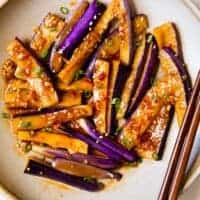
This spicy eggplant stir fry is an easy, flavorful side dish that is great for dinner. In this recipe, I shallow fry eggplant, which cooks the eggplant without turning it mushy. Shallow frying also preserves the beautiful purple color of the skin the best. See cooking notes for alternative methods of cooking the eggplant. Feel free to adjust the amount of spice specified below to suit your taste.
Ingredients
- 1 pound (454g) Chinese or Japanese eggplant, (see note 1)
- 3/4 cup (175mL) canola oil, or any neutral oil
- 1/2 cup (120mL) water
- 1/4 teaspoon cornstarch
- 2 teaspoons red Sichuan peppercorn, optional (see note 2)
- 2 tablespoons minced garlic
- 1 tablespoon minced ginger
- 2 tablespoons doubanjiang, (see note 3)
- 1 1/2 teaspoons gochugaru (Korean pepper flakes), (see note 4)
- 2 teaspoons sugar, (see note 5)
- 1/2 teaspoon (2g) kosher salt or 1/4 teaspoon sea salt, add more to taste
- sliced scallions for garnish
- toasted sesame seeds for garnish
Instructions
Cook Eggplant
- Slice the eggplant into 2.5 to 3-inch sections. Then, slice each section into batons (or strips) that are about 1/4 to 1/2-inch thick. You don’t need to salt the eggplant for this recipe (see note 6 for more info). Set the eggplant aside.

- Add 3/4 cup of oil to a wok and heat it over medium-high heat (see note 6). Once the temperature reaches about 350ºF to 360ºF (175ºC to 180ºC), it is ready for frying. You can test the temperature with a thermometer or by taking a small piece of eggplant and adding it to the wok. If the oil around the eggplant bubbles rapidly, the oil is ready for frying.
- Working in batches, add a large handful of eggplant batons to the wok. Fry for about 1 to 2 minutes, flipping the eggplant halfway. Using tongs, transfer the eggplant batons into a spider spatula. Give the spider spatula a gentle shake to shake off any excess oil from the eggplant. Then, transfer the flash-fried eggplant to a plate and flash fry another batch of eggplant batons. Eggplant absorbs oil like a sponge. After about 2 or 3 batches of frying, you’ll notice that there’s less oil in the wok. As a result, you’ll want to fry in smaller batches for the remaining eggplant. You can also add more oil to the wok.
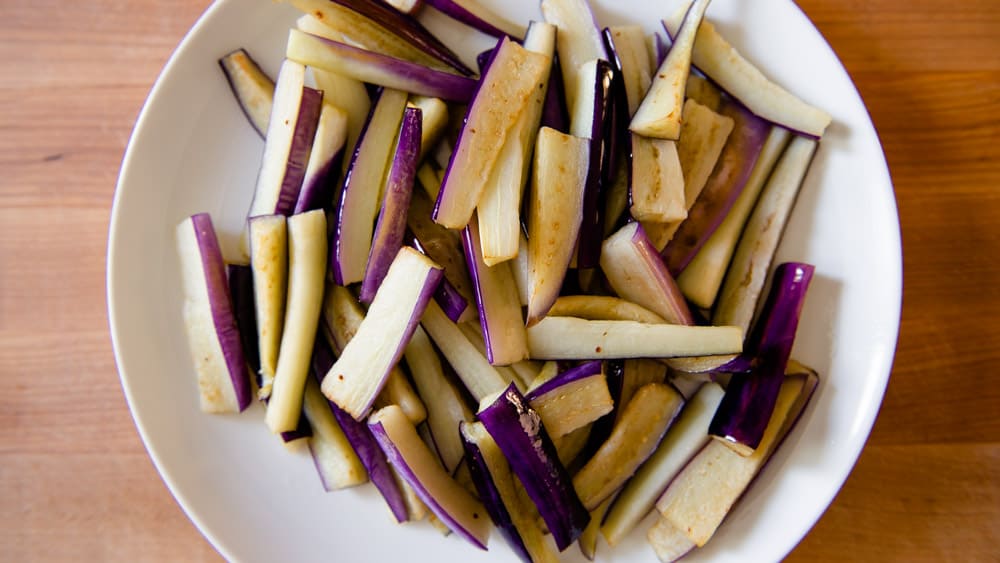
- Once all the eggplant has been cooked, turn off the heat. Pour some of the excess oil into a heat-safe bowl, leaving about 2 tablespoons of oil in the wok. (See note 7)
Prepare Sauce
- In a small bowl, make a cornstarch slurry by whisking the water with the cornstarch. This slurry will thicken the sauce later.
- Pour the Sichuan peppercorns into a bowl. Pick out any small twigs or tiny black seeds. The seeds are bitter and inedible, so don’t bother grinding them.

- Using a pestle and mortar, grind the Sichuan peppercorns until they turn into powder and you can no longer grind the husks any further. The husks won’t break down further and have a tough texture. Sift out the husks through a mesh strainer. You should now have about 1/2 teaspoon of ground peppercorn powder.

- Heat the wok (with the 2 tablespoons oil in it) over medium-high heat again. Add the garlic and ginger and cook for about 30 seconds to 1 minute, until fragrant. Next, add the doubanjiang and stir. Cook for another 30 seconds. Then, add the ground Sichuan peppercorn, gochugaru, sugar, and salt. Stir to combine.
- Whisk the cornstarch slurry again to loosen any starch that settled to the bottom of the bowl. Pour the slurry into the wok. Bring the liquid to a rapid boil and let the sauce simmer for 30 seconds to a minute to allow the sauce to thicken slightly.
Toss Eggplant with Sauce
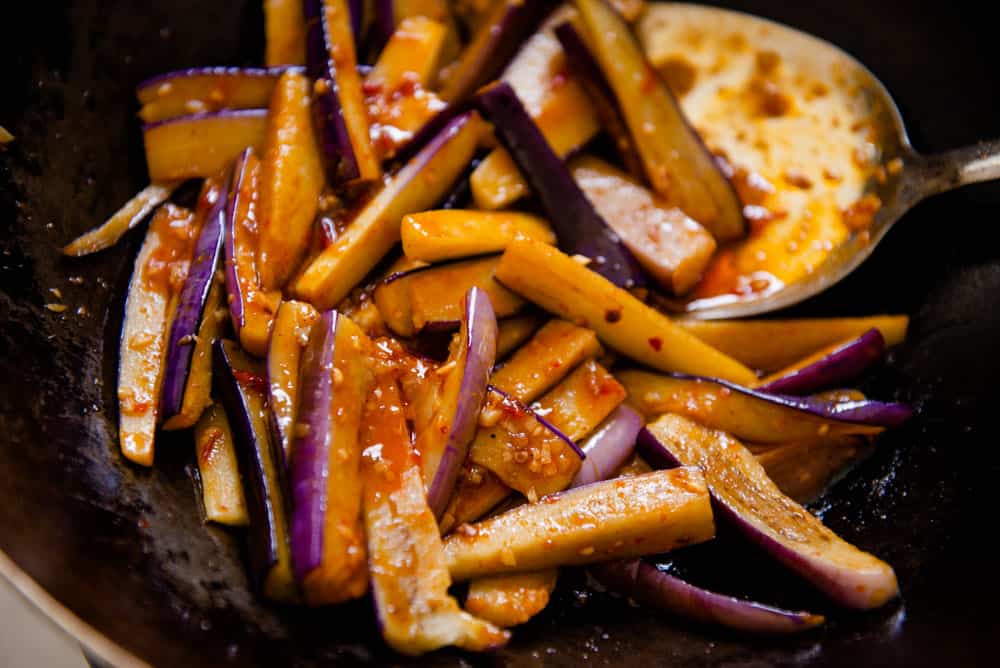
- Add all the eggplant back into the wok and stir to combine with the sauce. Turn off the heat and transfer the eggplant to a serving plate. Garnish the spicy eggplant with sliced scallions and toasted sesame seeds, if desired. Serve the spicy eggplant stir fry with jasmine rice or brown rice.
Notes
- Chinese or Japanese eggplant are long eggplant with relatively tender seeds (see photo in the post for a visual reference). It is fine if the amount of eggplant you have is slightly over a pound. However, you don’t want to go too much over 18 to 20 ounces, as there won’t be enough sauce to season the eggplant well.
- Note about Sichuan peppercorns: Green Sichuan peppercorns are not the same as the red ones. Green peppercorns have a grassy flavor. In the original version of this recipe, I used 1 teaspoon of Sichuan peppercorns, ground it, but didn’t sift out the husks. This also yielded about 1/2 teaspoon of ground peppercorns (with the husks). However, I always sift out the husks nowadays, and recommend starting with 2 teaspoons of peppercorns for this recipe.
- Doubanjiang: The spice level of doubanjiang (a salty fermented broad bean sauce) varies across brands. If you’ve never cooked with doubanjiang before, taste it first. If it seems very spicy, you’ll probably only want to use 1 tablespoon of it. If the spice level is on the low to medium spice range, use 2 tablespoons of it. Wondering what to do with leftover doubanjiang? Use it to make my mapo tofu, mapo chickpeas with potatoes, or spicy peanut noodles.
- Gochugaru is Korean pepper flakes that have a bright flavor and relatively low level of spice. You can substitute it with Diaspora Co’s Guntur Sannam Chilli or Aleppo pepper. Note that Aleppo pepper tends to be more spicy, so you may want to use less of it in the sauce.
- The sugar balances out the flavors of the fermented flavors of the doubanjiang. If you want to avoid using additional sugars, you can omit it.
- Using a saucepan to cook eggplant: If you don’t have a wok, you can fry the eggplant in a saucepan but in smaller batches. You can also use a large pan to fry the eggplant, but you’ll likely need to use more oil so that the amount of oil is deep enough for frying.
- What to do with leftover oil: I usually reuse the oil that I used to fry eggplant. Strain out any seeds or brown bits from the oil and then transfer it to a jar. Refrigerate and use within 2 weeks.
- Pan-frying directions: If you want to avoid shallow frying the eggplant, you can pan fry the eggplant in a large pan over medium-high heat. Eggplant absorbs oil quickly, so use a generous amount of oil when pan-frying. Otherwise, the eggplant might come out dry. Pan fry the eggplant for about 1 to 2 minutes and then flip over the pieces to pan fry the other side for another minute or so, until golden.
- Air-frying directions: Preheat the air fryer to 350ºF (175ºC). Toss the eggplant with 2 to 3 tablespoons of oil (any vegetable or olive oil works). Working in two batches, cook the eggplant for 5 to 6 minutes, until the eggplant pieces are golden.
- Steaming directions: Steam the eggplant in a bamboo steamer lined with parchment paper for 5 to 6 minutes, until the eggplant is soft. I think the eggplant turns too soft for this particular recipe, but it’s a good method if you don’t want to consume as much oil. Be very careful when you toss the steamed eggplant with the sauce.
- The nutrition information below is a rough estimate because it's difficult to measure how much oil is absorbed into the eggplant during the flash frying process.
Nutrition
Serving: 1serving | Calories: 321kcal | Carbohydrates: 12.2g | Protein: 2.7g | Fat: 30.3g | Saturated Fat: 2.3g | Sodium: 797mg | Fiber: 3.9g | Sugar: 7.1g
Did you make this recipe?Tag @hellolisalin or leave a star rating and comment on the blog!